
Last Updated: May 1, 2026
Mental health counselors play a vital role in supporting individuals facing emotional and psychological challenges—and entering the field typically requires a master’s degree. For many aspiring counselors, online programs offer a flexible, accessible, and often more affordable path to earning this credential.
2026 Online Mental Health Counseling Tuition Benchmark
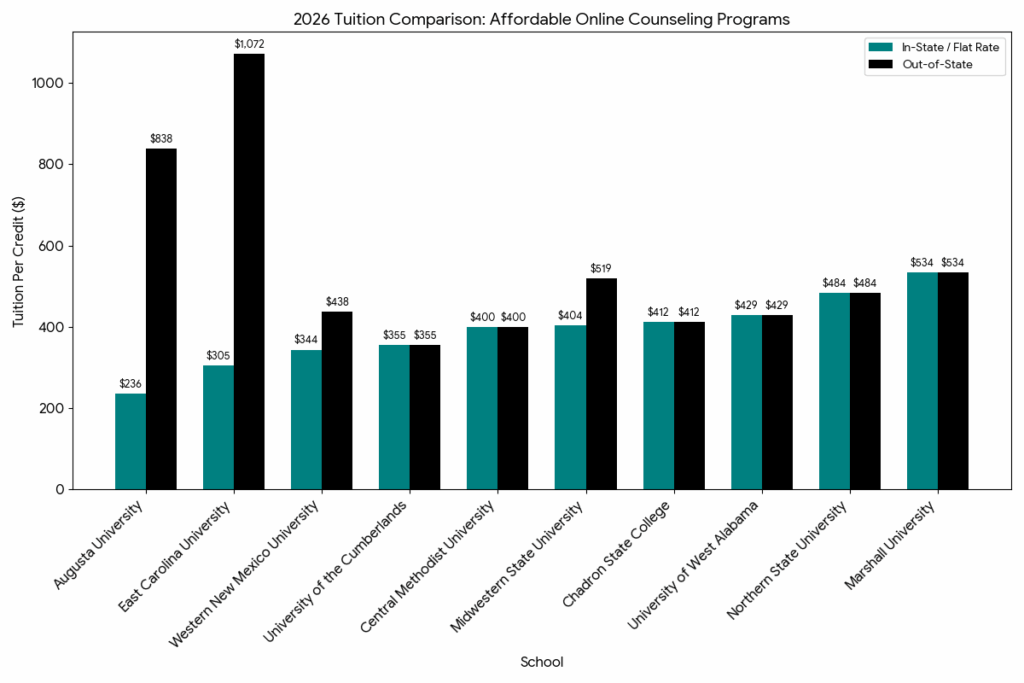
For a 60-credit, licensure-track online master’s in clinical mental health counseling (CMHC), “affordable” tuition in 2026 ranges from $236 to $534 per credit. However, the most cost-effective path is now defined by Flat-Rate Tuition—where out-of-state students pay the same as residents—and programs with Integrated Certification (e.g., Telehealth or Trauma), which can save graduates thousands in post-grad specialization costs.




This guide explores the most affordable online master’s in mental health counseling programs, along with key factors to consider as you evaluate cost, quality, and long-term value.
Overview of Online Master’s in Mental Health Counseling Degrees
An online master’s in mental health counseling prepares students to become licensed professionals who support individuals dealing with anxiety, depression, trauma, addiction, and other mental health challenges. These programs are designed to build clinical competencies in areas like assessment, diagnosis, counseling techniques, and ethical practice—often with the flexibility working adults need.
Online programs typically combine asynchronous coursework with synchronous sessions or local clinical placements. Core subjects often include human development, group counseling, psychopathology, multicultural counseling, and research methods. While most coursework can be completed remotely, students are still required to complete supervised field experiences to meet licensure requirements.
Graduates are eligible to pursue licensure as professional counselors (titles vary by state) and work in settings such as private practice, schools, hospitals, nonprofit organizations, and community mental health centers.
2026 Most Affordable Online Master’s in Mental Health Counseling Degrees
The programs below represent some of the most affordable CACREP-accredited online master’s in mental health counseling currently available. Tuition estimates are based on per-credit rates, with most programs requiring approximately 60 credits to graduate—standard for this degree path.
This list is not exhaustive, but it offers a helpful starting point for students seeking cost-effective options. While affordability is a key consideration, it’s important to evaluate additional factors such as program flexibility, alignment with licensure requirements, clinical placement support, faculty expertise, and student outcomes.
Because tuition rates and fee structures can change, we strongly recommend visiting each program’s official website for the most accurate and up-to-date information.
2026 Affordable Program Comparison Table
Estimated for a standard 60-credit licensure-track degree.
| School | In-State (Per Credit) | Out-of-State (Per Credit) | Est. Total Degree (In-State) |
| Augusta University | $236 | $838 | **$14,160** |
| East Carolina Univ. | $304 | $1,071 | **$18,290** |
| Western New Mexico | $344 | $437 | $20,637 |
| Univ. of the Cumberlands | **$355** | $355 | $21,300 |
| Central Methodist | $400 | $400 | $24,000 |
| Midwestern State | $404 | $519 | $24,240 |
| Chadron State | $412 | $412 | $24,720 |
| Univ. of West Alabama | $429 | $429 | $25,740 |
| Northern State | $484 | $484 | $29,046 |
| Marshall University | $534 | $534 | $32,040 |
The “Out-of-State” Alert
- The In-State Winner: If you live in Georgia, Augusta University is the undisputed champion of 2026, offering a 60-credit degree for under $15,000.
- The Flat-Rate Winner: For anyone living outside of Georgia or North Carolina, University of the Cumberlands ($355/credit) and Western New Mexico University ($344/credit) offer the most stable ROI, as their “out-of-state” rates are lower than many other schools’ resident rates.
- The 2026 “Sticker Shock”: Note that East Carolina University has a nearly $44,000 difference between its in-state and out-of-state total costs. If you aren’t a North Carolina resident, this program moves from the “cheapest” category to one of the most expensive.
Choosing a CACREP-accredited program ensures your degree meets national standards, facilitating smoother licensure and participation in the Counseling Licensure Compact, which allows practice across multiple participating states.
Augusta University
Location: Augusta, Georgia
Degree: Master of Education (M.Ed.) in Counselor Education
Tuition: $236 per credit (in-state), $838 per credit (out-of-state)
Program Overview: Augusta University’s M.Ed. in Counselor Education prepares students for licensure and professional practice in either school or clinical mental health settings. The program offers two CACREP-accredited concentrations and is tailored for working professionals, with classes primarily held in the evening. Students gain real-world experience through required internships and can enhance their education through graduate assistantships and community-based volunteer opportunities.
Program Website
Central Methodist University
Location: Fayette, Missouri
Degree: Master of Science (M.S.) in Clinical Counseling
Tuition: $400 per credit
Program Overview: Central Methodist University’s Master of Science in Clinical Counseling prepares graduates for licensure as Licensed Professional Counselors (LPCs) in Missouri. Delivered fully online with required in-person residencies, the program emphasizes evidence-based practice, social consciousness, and developmental understanding across the lifespan. Students gain academic knowledge, counseling skills, and clinical experience to work in diverse mental health settings, including correctional facilities, community agencies, and private practice.
Program Website
Chadron State College
Location: Chadron, Nebraska
Degree: Master of Arts in Education (M.A.E.) – Clinical Mental Health Counseling
Tuition: $412 per credit
Program Overview: Chadron State College’s Master of Arts in Education in Clinical Mental Health Counseling is designed for individuals pursuing licensure and professional practice in mental health counseling. The program emphasizes ethical practice, cultural competency, and evidence-based interventions. With a focus on working with diverse and marginalized populations, students are trained in counseling theory, assessment, diagnosis, and treatment planning. The curriculum supports a strong counselor identity and prepares graduates for clinical roles in various mental health settings.
Program Website
East Carolina University, College of Education
Location: Greenville, North Carolina
Degree: Master of Science (M.S.) in Counselor Education
Tuition: $304.84 per credit (in-state), $1,071.84 per credit (out-of-state)
Program Overview: East Carolina University’s online Master of Science in Counselor Education is designed to prepare culturally competent, ethically grounded professionals to serve in schools, colleges, and community agencies. The program offers three specialization areas and emphasizes flexible learning with the support of experienced faculty. While primarily online, students attend two short on-campus residencies as part of the CACREP requirements. Graduates are equipped to meet licensure requirements in North Carolina and pursue diverse roles in the counseling field.
Program Website
Marshall University
Location: South Charleston, West Virginia
Degree: Master of Arts (M.A.) in Counseling
Tuition: $534 per credit
Program Overview: Marshall University’s online Master of Arts in Counseling program is designed for flexibility and professional readiness, offering two emphases—Clinical Mental Health Counseling and School Counseling. The curriculum blends self-paced and live instruction, allowing students to balance academics with other responsibilities. CACREP-accredited and aligned with national licensure standards, the program equips graduates for roles in diverse mental health and educational settings and supports mobility across states through the counseling licensure compact.
Program Website
Midwestern State University
Location: Wichita Falls, Texas
Degree: Master of Arts (M.A.) in Clinical Mental Health Counseling
Tuition: $404 per credit (in-state), $519 per credit (out-of-state)
Program Overview: Midwestern State University’s master’s program in Clinical Mental Health Counseling prepares students for licensure and practice as professional counselors in Texas. The program includes the required academic coursework, clinical training, and supervised experience to sit for the National Counselor Examination and pursue licensure as a Licensed Professional Counselor Associate. With CACREP accreditation, the program supports high-quality preparation for work across a variety of mental health settings.
Program Website
Northern State University
Location: Aberdeen, South Dakota
Degree: Master of Science in Education (M.S.Ed.) in Counseling
Tuition: $484.10 per credit
Program Overview: Northern State University’s M.Ed. in Counseling provides a flexible, CACREP-accredited pathway to licensure in either clinical mental health or school counseling. Delivered in a HyFlex model, the program allows students to attend classes remotely while benefiting from live, interactive instruction and hands-on field experience. The curriculum emphasizes diversity, ethical practice, and professional development, with newly implemented residency components that support skill-building and faculty feedback in real-time.
Program Website
University of the Cumberlands
Location: Williamsburg, Kentucky
Degree: Master of Arts (M.A.) in Clinical Mental Health Counseling
Tuition: $355 per credit
Program Overview: The University of the Cumberlands offers a fully online, CACREP-accredited master’s program in Clinical Mental Health Counseling designed to prepare students for licensure and practice as professional counselors. The program emphasizes skill development for working with individuals, families, and groups across diverse populations and age ranges. Students benefit from a curriculum that integrates theory, diagnosis, and treatment planning, while gaining practical experience to meet licensure requirements and serve a growing need in mental health services.
Program Website
University of West Alabama
Location: Livingston, Alabama
Degree: Master of Science (M.S.) in Clinical Mental Health Counseling
Tuition: $429 per credit
Program Overview: The University of West Alabama’s online master’s in clinical mental health counseling provides students with the skills needed to support individuals, couples, families, and groups in a range of settings. The program is designed to meet core CACREP educational components required for counseling licensure in most states. Students benefit from mentorship opportunities through the UWA Mentor Collective, and courses are taught by licensed mental health counselors. Admission is competitive, with limited space in each cohort.
Program Website
Western New Mexico University
Location: Silver City, New Mexico
Degree: Master of Arts (M.A.) in Counseling
Tuition: $343.96 per credit (in-state), $437.59 per credit (out-of-state)
Program Overview: Western New Mexico University’s counseling program prepares students for licensure in clinical mental health counseling, school counseling, addiction counseling, and clinical rehabilitation counseling. Though not CACREP-accredited at the time of this writing, the program is undergoing formal review, and students graduating within 24 months of accreditation will be recognized as having completed a CACREP-accredited program. The curriculum is designed to meet licensure requirements in New Mexico and supports preparation for national certifications (e.g., NCC, CRC, BC-TMH). Students also benefit from free telemental health counseling training and may qualify for funding through the Expanding Opportunities Project if they commit to working in rural NM schools.
University Website
Regional Reciprocity: The “In-State Rate” Hack for 2026
If you live in the West or the South, you may qualify for significantly reduced tuition at out-of-state public universities through regional compacts. In 2026, these agreements are the most effective way to attend a top-tier state school for the price of a local one.
1. The WICHE / WRGP Discount (Western States)
The Western Regional Graduate Program (WRGP) allows residents of 16 Western states and territories to attend participating out-of-state graduate programs while paying no more than 150% of the resident tuition rate.
- Member States: AK, AZ, CA, CO, HI, ID, MT, NV, NM, ND, OR, SD, UT, WA, WY, and the Pacific Islands.
- The Savings: At a school like Adams State, a WICHE-eligible student could save over $10,000 compared to the standard non-resident rate.
- Pro-Tip: You must check the WICHE Savings Finder to see if the specific Counseling program is a participant.
2. The SREB Academic Common Market (Southern States)
If your home state does not offer a specific counseling specialization (e.g., Clinical Rehabilitation Counseling), the SREB Academic Common Market may allow you to study out-of-state at in-state tuition rates.
- Member States: AL, AR, DE, FL, GA, KY, LA, MD, MS, OK, SC, TN, TX, VA, and WV.
- How it works: This is a “program-to-program” agreement. If a public university in a neighboring state offers a degree yours doesn’t, you can often waive the out-of-state fee entirely.
3. The “Flat-Rate” Safety Net
If you don’t live in a reciprocity state, prioritize schools with a National Online Rate. Universities like University of the Cumberlands ($449/credit) and Chadron State ($412/credit) effectively act as their own reciprocity zones, offering the same budget-friendly price to a student in New York as they do to one in Kentucky or Nebraska.
- 2026 Strategy: Before applying, call the Financial Aid office and ask: “Do you participate in WRGP or the Academic Common Market for online counseling students?” This one question could save you the equivalent of a down payment on a house.
Consider a Featured Online Counseling Program
| School and Program Information | Online Program? Entry Requirements | Course Information | |
|---|---|---|---|
|
Walden University
MS in Clinical Mental Health Counseling
 CACREP Accredited CACREP Accredited |
✔ Online
GRE scores not required
|
Prepare to become the competent, compassionate counselor you were meant to be with Walden's CACREP-accredited MS in Clinical Mental Health Counseling program.
|
Learn More |
|
Northwestern University
Online MA in Counseling
CACREP Accredited |
✔ Online
GRE Not Required
Bachelor's Required |
CACREP-accredited online Master of Arts in Counseling from The Family Institute at Northwestern University. Prepare to pursue licensure in as few as 18 months.
|
Learn More |
|
Liberty University
MA: Clinical Mental Health Counseling
CACREP Accredited |
✔ Online
Online with required intensives
|
Our CACREP-accredited online master’s in counseling helps you become a skilled mental health counselor ready to empower others for positive change.
|
Learn More |
|
Mid-America Christian University (MACU)
Master of Science (MS) in Counseling
Higher Learning Commission (HLC)
|
✔ Online
100% Online
|
Oklahoma’s largest MS in Counseling program, with emphases in addiction and substance abuse, applied behavioral science, clinical mental health counseling, and more!
|
Learn More |
|
The Chicago School
M.A. in Clinical Mental Health Counseling
CACREP Accredited |
✔ Online
Bachelor's Degree Required.
|
This online, CACREP-accredited CMHC program prepares students for a career offering mental health services in a variety of settings.
|
Learn More |
|
Colorado Christian University
Clinical Mental Health Counseling, M.A. - Online Curriculum
CACREP Accredited |
✔ Online
Bachelor's Degree
|
Optional program emphasis in Marriage and Family Therapy and Substance Use Disorders. CACREP-accredited.
|
Learn More |
|
Butler University
Master of Science in Mental Health Counseling
|
✔ Online
Bachelor's Degree Required
|
Graduates are prepared to go on to become licensed counselors in addictions and mental health in select states. Graduate in just 2.5-3 yrs.
|
Learn More |
|
University of West Alabama
Online MS in Clinical Mental Health Counseling
CACREP Accredited |
✔ Online
Personalized education
|
An online CACREP-accredited graduate program from one of the most affordable institutions in the state.
|
Learn More |
|
Lamar University
Master of Education in Clinical Mental Health Counseling
SACSCOC Accredited
|
✔ Online
No GRE Required Minimum 3.25 Undergrad GPA
|
Through training and practical experience, students learn tools and techniques to guide persons coping with complex emotional difficulties.
|
Learn More |
*Sponsored Counseling Programs
For detailed degree information, view the guides to:
Online CACREP Accredited programs | Online MPCAC Accredited programs
Potential Hidden Costs to Watch for in Online Master’s of Counseling Degrees
While online master’s programs in mental health counseling can be more affordable than traditional options, students should be aware of potential hidden expenses that may impact the total cost of earning a degree. These costs are not always included in tuition quotes and can vary significantly by institution.
1. Technology and Online Learning Fees
Many programs charge additional fees for using learning management systems, virtual classroom platforms, or tech support services. These charges may appear each term and can add hundreds of dollars annually to your total expenses.
2. Fieldwork and Practicum Costs
Although coursework is online, clinical placements and supervised practicum hours must typically be completed in person. Students may need to cover costs related to travel, background checks, fingerprinting, liability insurance, or professional attire.
3. Textbooks and Course Materials
Digital courses may still require expensive textbooks, software licenses, or supplemental materials. Some schools do not bundle these costs into tuition, so students should budget separately for each course.
4. Graduation and Licensing Fees
Some institutions charge a graduation fee. After graduation, you’ll also need to pay fees for licensure exams, application processing, and ongoing certification or continuing education.
5. Transfer Credit Evaluation or Credit Cap Policies
Students bringing in credits from other institutions may face evaluation fees or be limited in how many credits they can transfer, potentially requiring more coursework than anticipated.
6. Residency Requirements
A few online programs have mandatory in-person residency components—multi-day on-campus intensives that require travel and lodging. These aren’t always clearly advertised in promotional materials.
How to Evaluate “True Cost” & ROI Beyond Tuition
When comparing online master’s in mental health counseling programs, it’s easy to focus solely on tuition. But the most affordable program on paper isn’t always the best long-term investment. To make a well-informed decision, students should consider the total cost of attendance and the potential return on investment (ROI) based on career goals.
1. Total Cost of Attendance vs. Per-Credit Tuition
Tuition rates are typically listed per credit, but programs vary in how many credits they require for graduation. A lower per-credit rate may still lead to higher total tuition if the program is longer or includes more required electives. Always calculate the full program cost, not just the credit-hour rate.
2. Completion Time and Flexibility
Some online programs allow students to accelerate their studies, while others follow a fixed schedule. A flexible or faster program may reduce how long you pay for living expenses, tech fees, and opportunity costs (like time away from full-time work).
3. Licensure and Employment Support
A program that provides strong clinical placement support, licensure exam prep, and job placement assistance may offer better ROI—even if it costs slightly more upfront. Consider how well the school supports your professional transition.
4. Scholarships, Grants, and Assistantships
Affordability isn’t just about sticker price. Some institutions offer generous scholarships, stipends, or employer partnerships that can dramatically reduce out-of-pocket costs. These opportunities can make a higher-cost program more financially viable.
5. Alumni Outcomes and Earning Potential
Investigate graduation rates, licensure pass rates, and employment statistics. Programs with strong alumni networks and high placement rates are more likely to yield a better long-term return—even if the tuition is moderately higher.
6. Debt Load and Repayment Terms
Estimate how much debt you may incur, and compare loan repayment scenarios. Use federal student loan calculators to assess monthly payments under various income-driven plans and how long it may take to reach full repayment based on your expected post-graduation salary.
The ROI of Accreditation: Why Non-CACREP Is a Budget Risk
While a non-CACREP program might save you $5,000 in tuition today, it could cost you $20,000 in lost wages and “bridge” credits tomorrow. In 2026, the counseling profession has reached a tipping point where CACREP (Council for Accreditation of Counseling and Related Educational Programs) is no longer a “bonus”—it is the baseline for financial safety.
1. The “State Board” Tax: Remedial Credits
Several states—including Ohio, North Carolina, and Kentucky—now require a CACREP-accredited degree for licensure, with almost no exceptions.
- The Risk: If you graduate from a non-CACREP program and move to one of these states, the board may require you to take 12–18 additional graduate credits at a different university to “fix” your degree.
- The Cost: At 2026 graduate rates, those remedial credits will cost you roughly $6,000–$9,000, completely erasing your initial tuition savings.
2. The “Federal Employment” Barrier
If you want to work for the Department of Veterans Affairs (VA) or TRICARE (military health), you are often required to have a degree from a CACREP-accredited program.
- The Impact: These are some of the highest-paying and most stable roles in the field, offering PSLF-eligible salaries of $85,000+.
- The Budget Risk: By choosing a non-accredited program to save $5k, you are potentially locking yourself out of the top 10% of the salary market.
3. Portability and the 2026 Counseling Compact
The Counseling Compact is the biggest financial win for counselors in a decade, allowing you to practice in 35+ states.
- The Truth: While the Compact itself doesn’t strictly require CACREP for every single applicant, it requires your home state to have rigorous standards.
- The ROI: If your state board (like Florida as of July 2025) moves to a “CACREP-only” model, your non-accredited degree becomes a “single-state” license, preventing you from using the Compact to grow a multistate telehealth practice.
2026 Expert Verdict: In the long run, the “cheapest” degree is the one that is accepted everywhere. Unless you are 100% certain you will never leave your current state and never work for the federal government, a CACREP-accredited program is the only way to guarantee your ROI.
Tips for Funding an Online Master’s in Mental Health Counseling Degree
Even the most affordable online programs can present a financial challenge, but there are multiple strategies you can use to reduce out-of-pocket costs and minimize student loan debt. Here are some tips to help fund your graduate education more effectively:
1. Start with Federal Financial Aid
Complete the Free Application for Federal Student Aid (FAFSA) to determine your eligibility for federal loans, grants, and work-study opportunities. Many graduate students qualify for unsubsidized loans—even if they didn’t receive aid as undergraduates.
2. Explore Institutional Aid and Scholarships
Before applying, speak with a financial aid advisor at each school you’re considering. Many institutions offer merit-based scholarships, graduate assistantships, and tuition discounts for in-state or online-only students.
3. Search for External Scholarships
Look for scholarships offered by mental health associations, nonprofit organizations, and foundations that support graduate-level education in counseling or social services. Even small awards can add up over time.
4. Connect with Alumni or Current Students
Reach out to recent graduates or current students to ask about their experience with financial aid, scholarships, and payment plans. Their insights can help you uncover lesser-known funding opportunities.
5. Check with Your Employer
Some employers offer tuition reimbursement or professional development funding for employees pursuing degrees in counseling, especially in education, healthcare, or human services sectors.
6. Leverage Undergraduate Resources
Your undergraduate alma mater may offer career counseling or scholarship guidance for alumni pursuing graduate degrees. It’s worth checking in with their financial aid or alumni office.
The “Net-Zero” Roadmap: Strategies to Erase Your Tuition Balance
In 2026, savvy students don’t just look for low tuition; they use a “Stacking” strategy to reduce their out-of-pocket costs to zero. If you choose an affordable school like WNMU or Adams State, these three steps can effectively pay for your entire degree.
1. The Federal Stipend Stack (The “BHWET” Grant)
Many affordable public universities are designated as “High Need” institutions. These schools often host the HRSA Behavioral Health Workforce Education and Training (BHWET) grant.
- The Benefit: If your school is a participant, you can receive a $10,000 cash stipend during your internship year.
- The Action: Ask your admissions advisor: “Does this program currently offer BHWET stipends for clinical internships?”
2. Employer-Sponsored Bridge (Tuition Reimbursement)
In 2026, major healthcare systems and non-profits are struggling with a counselor shortage. Many will pay for your Master’s if you are already working for them in a lower-level role (like a Case Manager or Behavioral Tech).
- The Strategy: Find an employer that offers Tuition Reimbursement (often up to $5,250/year tax-free). Over a three-year part-time program, this covers $15,750 of your tuition—nearly the entire cost of the most affordable degrees on our list.
3. The “Associate” Income Hack
Once you graduate from a 60-credit accredited program, you are immediately eligible for your Associate License (LPC-A).
- The Financial Play: In 2026, the average LPC-A salary is $58,000. Because you chose a degree under $25k, your debt-to-income ratio will be low enough to qualify for Refinancing or aggressive repayment, allowing you to be completely debt-free within 24 months of graduation.
2026 Pro-Tip: Don’t forget the American Counseling Association (ACA) Foundation Scholarships. They offer several $500–$1,000 awards specifically for graduate students in CACREP programs. While small, these “micro-grants” can cover your clinical software fees and textbooks for the year.
Accreditation
When comparing affordable online master’s in mental health counseling programs, accreditation is a non-negotiable. No matter how low the tuition, a degree is only valuable if it meets the standards required for licensure and professional practice.
The gold standard in this field is accreditation by the Council for Accreditation of Counseling and Related Educational Programs (CACREP). CACREP-accredited programs are vetted for academic rigor, ethical training, and clinical preparedness—ensuring graduates are eligible to sit for licensure exams in most states.
Accreditation also applies to online programs. If you’re considering a remote degree, verifying CACREP status is an essential step in confirming the program’s legitimacy and long-term value.
Find your CACREP-accredited online counseling program
Types of Online Master’s in Mental Health Counseling Degree Programs
Many online master’s in mental health counseling programs offer concentrations or electives that allow students to tailor their education to specific populations or practice settings. While all graduates earn the same degree, choosing a specialization can help align your training with your intended licensure path or career focus.
Common concentrations include:
- Addiction Counseling: Focuses on substance use disorders and prepares students to work in rehabilitation centers, community agencies, or private practice.
- Clinical Counseling: Offers advanced training in diagnosis and treatment planning for a broad range of mental health conditions.
- Marriage and Family Therapy: Emphasizes relational dynamics and systemic approaches for working with couples and families.
- School Counseling or Educational Counseling: Prepares students to support K–12 or higher education students in academic, social, and emotional development (note: may lead to a separate licensure track).
- Student Affairs or College Counseling: Designed for those interested in working within college and university settings, focusing on student development and mental health services.
- Community Counseling or Community Care: Trains students to work in nonprofit, government, or grassroots organizations that serve diverse, often underserved populations.
When researching programs, be sure to explore which concentrations are available and whether they align with your state’s licensure requirements or long-term career goals.
Common Courses for Online Master’s in Mental Health Counseling Degree Programs
While course offerings vary by institution, most CACREP-accredited online master’s in mental health counseling programs include a core curriculum designed to prepare students for licensure and clinical practice. Below are some of the foundational courses typically included:
- Psychopathology and Diagnosis: Teaches students how to identify and assess mental health disorders using the DSM framework and evidence-based criteria.
- Counseling Theories and Interventions: Covers major theoretical approaches to therapy, such as cognitive-behavioral, psychodynamic, and person-centered counseling.
- Ethics and Professional Standards: Examines legal and ethical responsibilities in clinical practice, including confidentiality, informed consent, and cultural competence.
- Human Growth and Development: Explores psychological development across the lifespan and its implications for counseling interventions.
- Multicultural Counseling: Prepares students to work effectively with diverse populations and understand how culture, identity, and systemic factors affect mental health.
- Group Counseling: Introduces the theory and practice of facilitating therapeutic groups, including group dynamics, leadership styles, and intervention planning.
- Research and Program Evaluation: Builds skills in interpreting research, evaluating outcomes, and applying evidence-based practices.
- Practicum and Internship: Provides supervised clinical experience in approved settings, often required for graduation and licensure eligibility.
These courses ensure students graduate with both the academic foundation and practical skills needed to succeed as licensed mental health counselor.
 Walden University - MS in Clinical Mental Health Counseling (CACREP Accredited)
 Northwestern University - Online MA in Counseling (CACREP Accredited)
 Liberty University - MA: Clinical Mental Health Counseling (CACREP Accredited)
 Mid-America Christian University (MACU) - Master of Science (MS) in Counseling (Higher Learning Commission (HLC) Accredited)
 The Chicago School - M.A. in Clinical Mental Health Counseling (CACREP Accredited)
 Colorado Christian University - Clinical Mental Health Counseling, M.A. - Online Curriculum
 Butler University - Master of Science in Mental Health Counseling
 University of West Alabama - Online MS in Clinical Mental Health Counseling (CACREP Accredited)
 Lamar University - Master of Education in Clinical Mental Health Counseling (SACSCOC Accredited)
How to Choose a Master’s in Mental Health Counseling Program
Many factors go into choosing the best online master’s in mental health counseling program. These include:
- Academic excellence: There is no question that you should pursue a master’s at a school that provides you with a rigorous background and academic excellence. This means that the professors are masters-level or higher and have strong educational experiences in their teaching subjects.
- Real-world connections: A master’s degree will only do you good if you can use it to become employed or enroll in a Ph. D. level program. A program should help you earn a field placement, get your license, and ensure that you can use your degree to advance your career.
- Financial assistance and overall cost: As a graduate student, there is no question that you will be looking for the most affordable online master’s in mental health counseling program. However, the meaning of this affordability can vary. On the one hand, you want to ensure that the program offers you appropriate tuition assistance. Even affordable counseling programs may be out of your financial reach, so you’ll want to ensure that the school can help you get scholarships, aid, or loans that will allow you to pay tuition and get your master’s.
- Flexibility: One of the benefits of any online master’s program is its flexibility. This flexibility should allow you to take classes at night and on weekends to keep working or raising a family. Furthermore, many online master’s programs allow you to take asynchronous courses, meaning you can watch lectures on your own time. This flexibility may be ideal if you are working while getting your master’s degree.
Interested in the top mental health programs? Check out our guide on the top mental health graduate level degrees.
Master’s in Mental Health Counseling Degree Salary and Career Outlook
Earning a master’s in mental health counseling can open doors to a wide range of careers in clinical and community settings—and it’s a profession with strong job growth and solid earning potential.
Career Paths for Mental Health Counselors
Graduates of online master’s in mental health counseling programs are qualified to pursue roles such as:
- Licensed mental health counselor in private practice
- School or campus counselor
- Substance abuse or addiction specialist
- Crisis intervention counselor
- Military or veterans’ counselor
- Rehabilitation counselor
- Community mental health provider
- Consultant for government or nonprofit organizations
These professionals work in diverse environments, including outpatient clinics, schools, hospitals, residential treatment centers, and community health agencies.
Salary Expectations
According to the U.S. Bureau of Labor Statistics (BLS), the median annual wage for substance abuse, behavioral disorder, and mental health counselors was $59,190 as of May 2024.
Here’s how salaries break down by work setting:
- Hospitals (state, local, and private): $61,930
- Offices of other health practitioners: $59,570
- Outpatient mental health and substance abuse centers: $58,200
- Individual and family services: $57,080
- Residential facilities: $49,610
The top 10% in the field earned more than $98,210, while the bottom 10% earned less than $39,090.
Job Outlook
The field is experiencing significant demand. The BLS projects 17% job growth for these roles from 2024 to 2034, which is much faster than average across all occupations. This translates to approximately 81,000 new jobs over the decade, with about 48,300 job openings projected each year due to growth and workforce turnover.
The need for trained counselors continues to rise as more individuals seek mental health services, insurance coverage improves, and public awareness of mental health expands.
Conclusion
Earning an online master’s in mental health counseling can be both professionally rewarding and financially manageable—especially when you choose a program that balances quality, flexibility, and cost. While tuition is a key factor, understanding the full picture—including hidden fees, licensure alignment, and long-term career potential—can help you make a smarter investment.
By exploring accredited and affordable options, you’re taking an important step toward a meaningful career helping others. Be sure to research each program thoroughly, ask questions, and plan your finances wisely as you move forward on your path to becoming a licensed mental health counselor.
